High electricity bills have made a lot of Filipino homeowners and businesses curious about solar. But curiosity isn't a sale. Most people have questions first. How much will it cost? How much will I save? Is my roof suitable? What about brownouts? Who will maintain it?
A good solar website answers those questions honestly and makes the next step easy: booking a site survey or getting a proper quote.
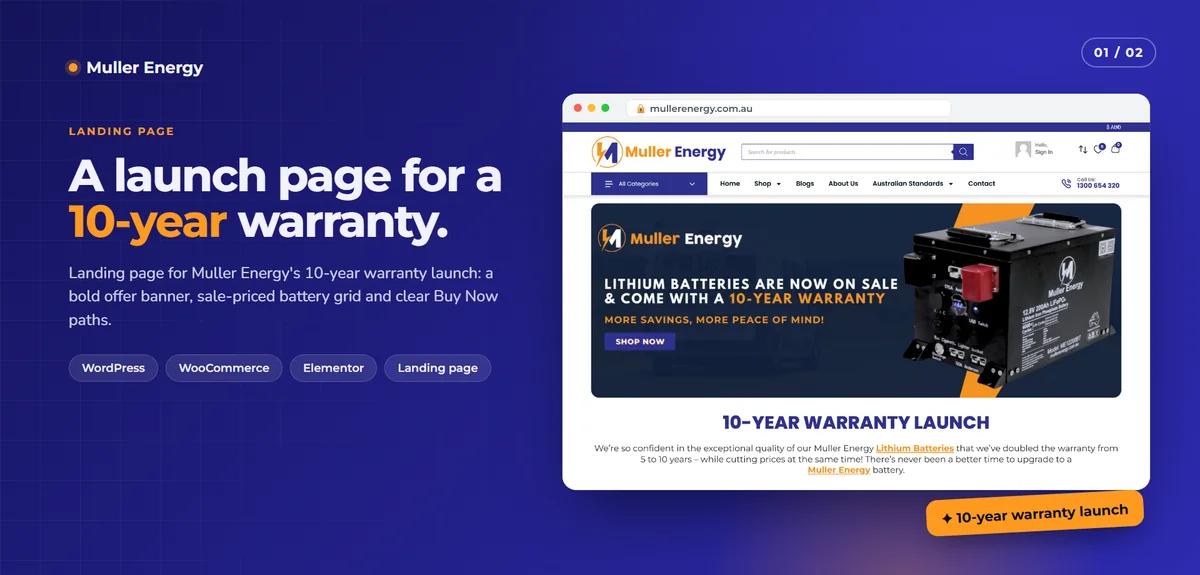
I'm Aldrian, an independent web developer in the Philippines. One of the projects in my portfolio is a campaign landing page for Muller Energy, an energy brand that sells lithium batteries. When Muller doubled its battery warranty to 10 years and cut prices, the launch needed one focused page that made the offer obvious and got shoppers to a product fast. I built it inside their existing WooCommerce store, with a campaign banner, a clear warranty message and a product grid where every card showed the warranty badge, old and new price, and buy buttons.
That project taught me a lot about presenting energy products clearly. Here's how I'd approach a website for a solar company.
What solar customers want to know
What you offer
Grid-tied, off-grid and hybrid systems, battery storage, solar water pumps, commercial and industrial installations. Each option explained in plain language with who it's for.
Packages
Many installers offer packages by system size. If you publish packages, each should show what's included: panels, inverter, batteries if any, mounting, installation, permits assistance and warranty. Prices can be shown as starting prices or left for the quote, depending on your preference.
How savings work
Customers want to understand how solar could lower their bill. A clear explanation of how it works, with honest examples, builds trust. If we add a savings estimator, it should be clearly labeled as an estimate, with the assumptions shown, so nobody feels misled.
Real installations
Photos of systems you've actually installed, with the location, system size and type. Nothing builds confidence like real roofs with real panels.
Warranties and after-sales service
Product and workmanship warranties, maintenance and monitoring. Solar is a long-term investment, and customers want to know you'll be around.
Financing options
If you offer installment plans or partner with banks, explain how they work.
Turning visitors into site surveys
Solar sales almost always start with a site visit or a bill review. Your website should make that step easy:
- A site survey request form with address, property type and average monthly bill
- Optional upload of a recent electric bill
- A quick estimate tool, clearly labeled as indicative. See quote calculators.
- Click-to-call and messaging links
Leads can go to your email, sales team or CRM, with automatic confirmations to the customer. More on lead generation websites.
Campaign and promo pages
Like the Muller Energy launch, solar companies often run promos: limited-time discounts, free battery upgrades or bank financing offers. A focused landing page for each campaign, with one clear message and one clear action, usually converts far better than sending people to a busy home page.
Product catalogs and online stores
If you sell panels, inverters, batteries or accessories directly, I can build a product catalog or an online store with specifications, data sheets, warranty information and local payment options.
Built for trust and speed
Solar is a big purchase, so trust matters. I build solar websites with:
- Real installation photos and accurate details
- Clear licenses, accreditations and certifications
- Honest savings explanations without exaggerated promises
- Fast, mobile-friendly pages
- Clean design that feels professional and modern
Common mistakes on solar websites
Guaranteed savings claims. Savings depend on usage, roof direction, shading and electricity rates. Promising fixed savings can backfire. Honest estimates work better.
No real installations. Stock photos of solar farms don't convince homeowners. Photos of homes in their area do.
Long quote forms. Asking for every technical detail up front scares people away. Ask for the basics, then follow up.
No after-sales information. Buyers want to know about warranties and maintenance before they commit.
Slow pages. Large hero images and heavy sliders hurt both conversions and rankings.
Being found by homeowners and businesses
People search for "solar installer Pampanga," "hybrid solar system price Philippines" or "solar for business Cebu." To show up:
- A page for each system type and service area
- Helpful guides that answer real questions
- Structured data for your business and products
- Fast, mobile-friendly pages
- A complete Google Business Profile with installation photos
Content that answers real questions
Solar buyers research for weeks before calling anyone. Helpful articles can bring them to you early: grid-tied vs hybrid systems, how net metering works, what happens during brownouts, how to read your electric bill, how long panels and batteries last. Written honestly and kept up to date, these pages build trust and give search engines more reasons to show your site.
How we'd work
- We talk about your systems, customers and sales process.
- You get a quote with scope, timeline and fixed price.
- We gather installation photos, packages and credentials.
- I build and share preview links.
- We test forms, estimators and pages on phones.
- We launch, and I show your team how to add projects and promos.
Let's turn interest into site surveys
Tell me about your solar business. I'll reply with a plan and a fixed quote.