A lot of small businesses start their website on a builder like Wix, Squarespace or a similar platform. It makes sense at first. You pick a template, drag some blocks around and you're online by the weekend.
Then a few years pass. You've paid the subscription every month, the site still looks like a template and you realize something uncomfortable: if you stop paying, it disappears. You don't really own it. You rent it.
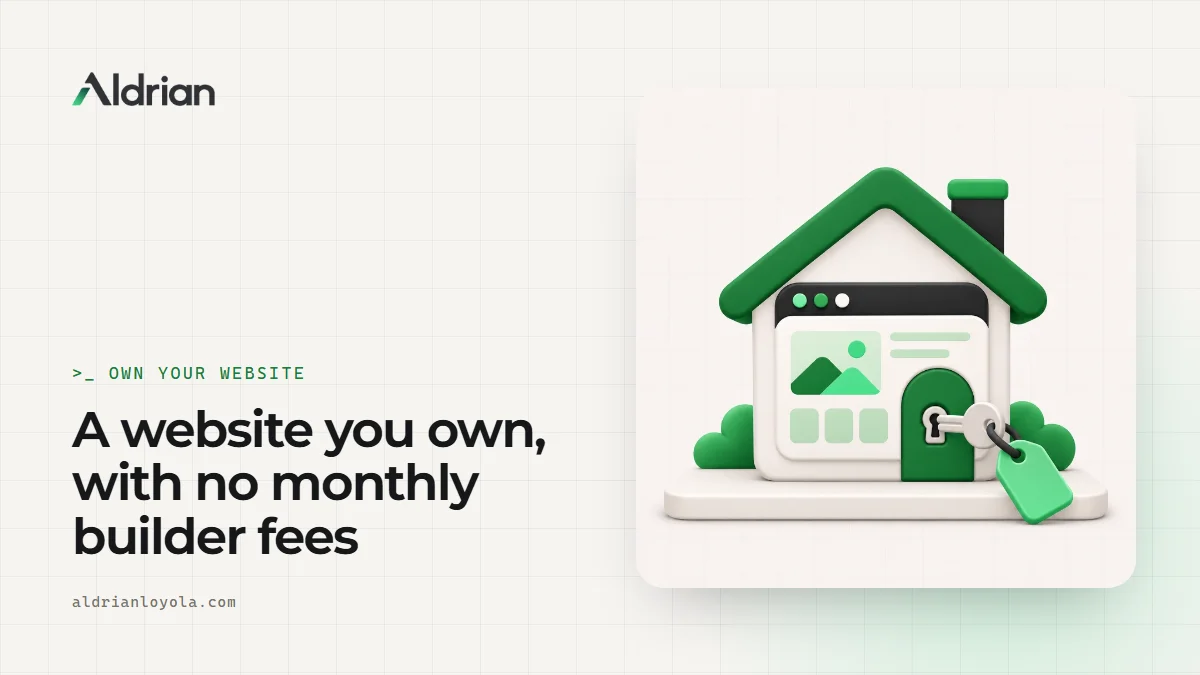
I build websites you actually own. Here's what that means and why it matters.
What "owning your website" really means
Ownership has four parts. Check how many you have today.
- Your domain is registered in your name, with your login.
- Your hosting account is yours, so you choose where the site lives and can move it.
- Your code is handed over to you, so any developer can work on it.
- Your content like text, photos and data can be exported and reused anywhere.
On most builder platforms, you only have the first one, and sometimes not even that. The design and code belong to the platform. You can't take them with you.
The real cost of a builder subscription
Builder subscriptions look small month to month. Add them up over a few years and the picture changes. Then add the extras: premium plans to remove ads or unlock features, app subscriptions for forms or bookings, and higher tiers for selling online.
None of that money builds anything you keep. When you eventually outgrow the platform, you start again from zero.
With a website you own, you pay for the build once. After that, your ongoing costs are usually:
- Your domain renewal
- Hosting, which for a light, well-built site can be very affordable
- Business email if you want it
- Optional maintenance, only if you need it
No platform fee, no lock-in and no surprise price increases you can't escape.
Why owned websites are often faster
Builders have to support every possible feature for every customer. That means a lot of extra code loads on your pages whether you use it or not.
A website built just for you only loads what it needs. That usually means faster pages, better Core Web Vitals and a better experience on phones with weak signal. Speed affects how long people stay, whether they contact you and how search engines rank you.
Your options for an owned website
There's more than one way to own your site. I'll recommend the one that fits how you work.
Hand-coded static website
Clean HTML, CSS and JavaScript, hosted on fast, inexpensive infrastructure. Ideal for service businesses, portfolios and landing pages that don't change daily. Very little to maintain and very little to attack. More on my hand-coded website page.
Lean WordPress site
If you want to edit pages and write blog posts yourself, WordPress is a solid choice. You own it completely. I keep it lean, with a clean theme and only the plugins you truly need, so maintenance stays light.
Static site with a simple editor
A middle ground. The public site is fast, static code, and you get a simple editor for the parts you update often, like news or team members.
What about editing my own content?
This is the main reason people stay on builders. They're afraid they won't be able to change anything without calling a developer.
You don't have to give that up. I'll set up editing for the parts you actually change, and leave the rest locked down so nothing breaks by accident. For everything else, small edits are quick for me to make, and many clients find that easier than logging in themselves.
Moving off a builder platform
If you're already on Wix, Squarespace, Webflow or similar, moving is very doable. The process I follow:
- Audit what you have. Pages, images, forms, blog posts and the URLs Google already knows.
- Plan the new structure. Keep what works, fix what doesn't.
- Rebuild the site with the same or improved content.
- Set up redirects so old links and rankings carry over.
- Move your domain to point at the new site, with no long downtime.
- Cancel the subscription once everything is confirmed working.
I go deeper into this on my Wix, Squarespace and Webflow migration page.
Is a builder ever the right choice?
Honestly, yes. If you're testing an idea, have very little budget and want to edit everything yourself today, a builder can be a fine starting point.
The time to switch is usually when one of these is true:
- You're paying for more add-ons every year
- The site feels slow or looks like everyone else's
- You need features the platform can't do well
- You want to stop renting and start owning
A quick ownership checklist
Before you sign with any developer, me included, ask for these in writing:
- The domain registered in your name and email
- The hosting account in your name, or a clear plan to move it to you
- A copy of the code or full access to where it's stored
- Admin logins for every service the site uses
- A list of any paid tools or licenses and when they renew
If a developer hesitates on any of these, think twice.
Ready to own your website?
Tell me what you have now and what you want. I'll suggest the simplest setup you can own outright, with a fixed price for the build.