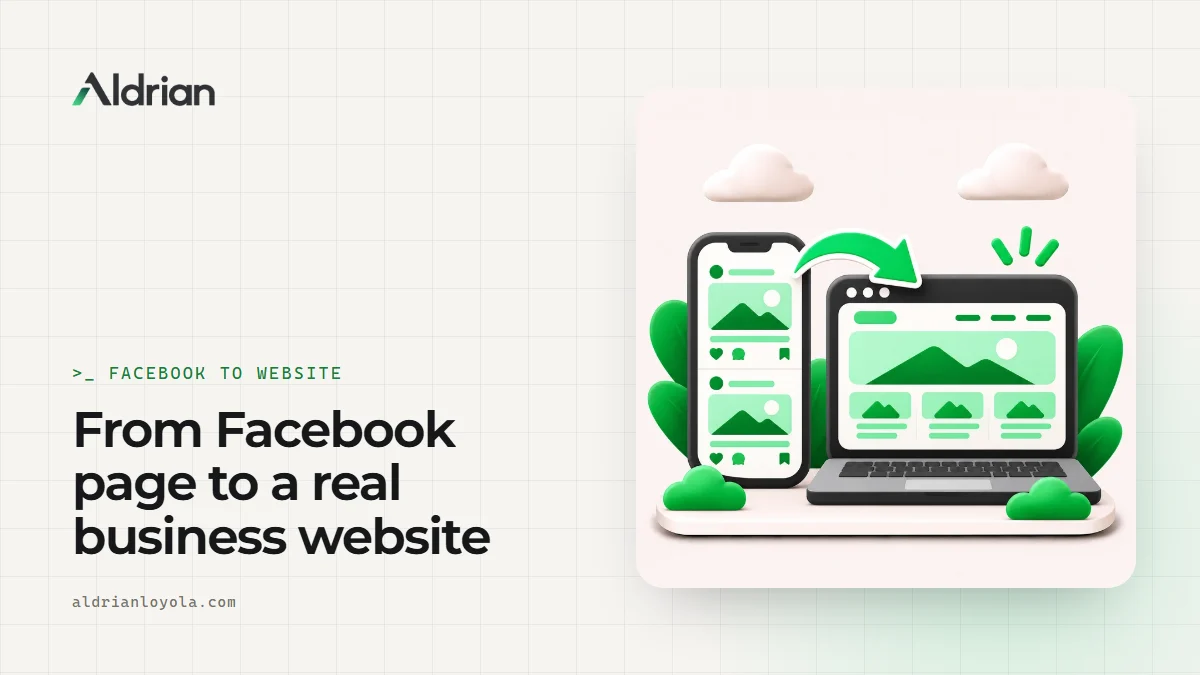
In the Philippines, Facebook is where a lot of businesses start. It's free, your customers are already there and you can post, chat and sell from your phone. Plenty of successful businesses still run mostly on a Facebook page.
So why bother with a website?
I'm Aldrian, an independent web developer in the Philippines. I help small businesses that started on Facebook take the next step with a simple, fast website they own. Here's an honest look at when it's worth it and what it should include.
What a Facebook page does well
Let's give it credit:
- Free to set up and run
- Easy to post updates, photos and promos
- Messenger makes it easy to chat with customers
- Your audience is already scrolling there every day
- Reviews and recommendations help word of mouth
Keep your page. A website isn't a replacement. It's the foundation underneath.
Where a Facebook page falls short
You don't own it
Your page lives on someone else's platform, under their rules. Accounts get hacked, restricted or disabled, sometimes with little warning. If that happens, your business can disappear overnight.
Reach is limited
Most of your followers won't see most of your posts unless you pay to boost them.
Hard to find on Google
When someone searches "cake shop in Marikina" or "aircon cleaning Cebu," a website with clear pages and proper SEO has a much better chance of showing up than a social media page.
Information gets buried
Your prices, menu, services, hours and policies get lost under months of posts. Customers ask the same questions in chat again and again.
Less credible for some customers
Corporate clients, foreign customers and bigger buyers often expect a real website and a business email. A Facebook-only presence can look small or temporary to them.
Limited features
Booking systems, online stores with proper checkout, quote forms and client portals work far better on a website.
What your first website should include
You don't need a huge site. A focused one with a few pages does the job:
- Home: what you do, who you serve and how to contact you, in a few seconds
- Products or services: clear descriptions, photos and prices or starting prices
- About: your story, your team and why customers can trust you
- Contact: phone, email, Messenger link, map, hours and a short form
- FAQs: answers to the questions you get in chat every day
Depending on your business, you might add online ordering, booking, a quote form or a small store.
Connecting your website and Facebook page
Your website and page should work together:
- Link your website on your Facebook page and Messenger auto-replies
- Add Messenger and Facebook links on your website
- Share website pages in your posts, so followers land on clear information
- Use your website for anything that needs a form, booking or payment
- Install tracking properly, if you run Facebook ads, so you can see what works
Getting found on Google
A website lets you show up in searches your Facebook page can't reach. I set up:
- Clear page titles and descriptions for your main services
- A page for each key product or service
- Structured data so Google understands your business
- Your Google Business Profile, linked to your site
- Fast loading on mobile
Keeping it affordable
A first website doesn't have to be expensive. Ways to keep costs down:
- Start with a small site and add pages later
- Use photos you already have from your page, if they're good quality
- Reuse the text from your posts and chats as a starting point
- Choose a lightweight build with low hosting costs and no monthly builder fees
More on pricing in my website cost guide, and on avoiding subscriptions in own your website.
Common mistakes when moving from Facebook
Building a site that's just a copy of the page. Your website should organize information clearly, not repeat your feed.
Embedding the Facebook feed as the main content. It's slow and adds little for visitors.
Forgetting a business email. An address on your own domain looks far more professional than a free email account.
Registering the domain under someone else's name. Always keep it in yours.
Launching and never updating. Outdated prices and hours hurt trust. Keep it simple enough that updates are easy.
What happens if your page gets restricted
It's worth thinking about before it happens. If your page is hacked or restricted, a website keeps you reachable. Customers searching your name still find your services, prices and contact details, and you can keep taking orders and inquiries through your own forms while you sort out the account. Many owners only realize how much they depend on one platform when it's suddenly gone.
Who this is for
Online sellers, home bakers, food businesses, salons and barbers, repair services, clinics, tutors, photographers, resorts, small shops and service providers who've grown on Facebook and want the next step.
How we'd work
- Send me your Facebook page and tell me what you want customers to do.
- I suggest a simple structure and features.
- You get a quote with scope, timeline and fixed price.
- I build using your content, improving it where needed, and share a preview.
- We test on phones and launch.
- I show you how to make simple updates.
Let's give your business a home you own
Send me your Facebook page link. I'll reply with a plan and a fixed quote.